
Subject guide
Open Educational Resources
Open educational resources, better known as OER, are freely accessible, reusable learning materials in various forms. OER can be extremely valuable for both teachers and students. On this page, we will discuss what OER entails, what their advantages and disadvantages are, what restrictions may apply to them, and where you can find them. Discover how open educational resources can enrich your teaching.
What are Open Educational Resources?
OER are learning materials that are free and freely accessible and that you can reuse, adapt and distribute without (or with few) restrictions. What is permitted depends on the licence associated with the material. In general, OER use internationally recognised Creative Commons (CC) licences, which allow you to see at a glance what is possible.
OER can include complete open textbooks, entire presentations or educational videos, often referred to as courseware. However, they can also be smaller building blocks such as images, infographics and datasets.
What's in it for me?
Why should you invest time in discovering the possibilities of OER, or put effort into developing and publishing them yourself?
- Cost savings: Students need to purchase fewer textbooks. In addition, it also saves money in the development of learning materials, especially for more expensive formats such as audiovisual material, as materials from others can be reused.
- Accessible learning: Because OER are free for students, education becomes more accessible. The difference between a student who has the means to purchase books and one who does not is eliminated.
- Quality improvement: Because the teacher makes educational materials available as OER, the educational community can provide feedback on the learning materials, which can be used to improve their quality.
- Fewer copyright barriers: Is a presentation by a colleague in your field basically useful, but does it need to be adapted for your teaching level, for example? Without copyright barriers, you can adapt the teaching materials so that you don't have to reinvent the wheel.
Succes stories Leiden University
OER in Leiden is developing rapidly. An incentive scheme awarded by Npuls has resulted in a cross-faculty team working on standardisation and best practices relating to OER. In addition, there are already several successful examples of open educational resources that have been developed at Leiden University:
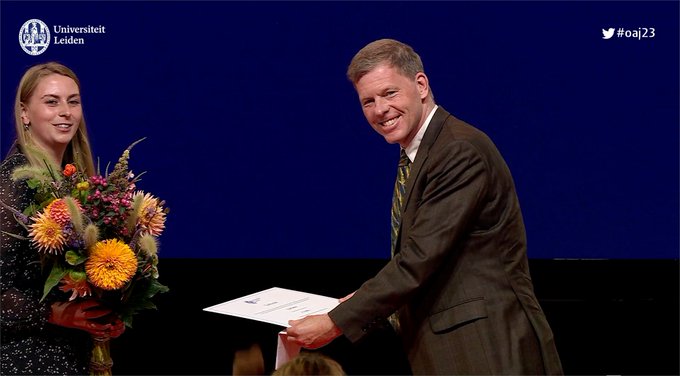
AnatomyTOOL developed by university lecturer Paul Gobée. After winning the Leiden Teaching Award in 2023 and the SURF Education Award in 2024, he was given the opportunity to talk to the dean about the importance of open educational resources.
On the podcast “Oudheid” (Antiquity), presenter Timo Epping talks to different Leiden University experts about aspects of antiquity within their field. All episodes are available via the OER platform Edusources. For example, listen to “Dames in Duel: vrouwelijke rivaliteit in Livius en Tacitus”. (Ladies in Duel: female rivalry in Livy and Tacitus).
The Massive Online Open Course “EU policy and implementation: making Europe work!”, developed by Professor Bernard Steunenberg and others, focuses on how the European Union develops its policies and how these are taken up and implemented by the Member States.
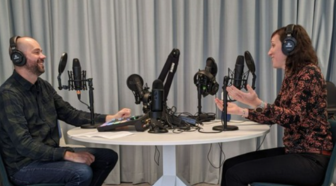
It is not through developing OER, but through her dissertation “Open to all, not known to all: sustaining practices with open educational resources in higher education” that Marjon Baas of ICLON is helping to raise awareness of OER. Listen to her insights in the In Context podcast.
Finding and using OER
Finding the most suitable learning materials for you can be quite time-consuming if you don't know where to look. This applies both to students who want to understand the material better and to teachers who want to enrich their teaching.
General sources: Google and Metafinders
As a search engine, Google has the ability to filter specifically for material that may be reused or shared under CC licences. This is particularly interesting for teachers who wish to use this in their own OER.

Metafinder platforms are special search engines that perform simultaneous searches across different OER platforms.
- CC Search Portal: With this metafinder, you first select the medium you are looking for (image, 3D model, music), which often makes the results more relevant.
- OASIS - searches 97 different sources.
- OER Metafinder - searches 22 different sources.
Platforms
There are various platforms that host collections of open educational resources. You can often filter these by a specific type of learning material, level, language, etc.
|
Platform |
Omschrijving |
Notitie |
|
Digital platform with Open Educational Resources especially for Dutch education. Everything is stored and made available through the platform SURF. |
Many of its contents are currently targeted at MBO institutions and less at Universities. |
|
|
Official, independent website of Kennisnet (a public organisation for education and ICT). |
At present, there is still many materials for secondary education only, and not as many for University-level education. |
|
|
A digital platform offering Open Educational Resources, launched by the Institute for the Study of Knowledge Management in Education (ISKME). |
Offers searching on material type, educational level and subject. |
|
|
A collection of teaching materials for university lectures, including textbooks, syllabuses, lecture assignments and exams; developed by the Washington State Colleges. |
When you access through Google Docs, you can immediately see which materials were used in which classes. |
|
|
Multimedia Educational Resource for Learning and Online Teaching (MERLOT) provides access to curated online learning and support materials, developed under the guidance of an international community of teachers, students and researchers. |
Many links to external applications and databases. However, there are clear user and peer ratings. |
|
|
Open Educational Resources by American Universities and colleges. |
Some materials are still only accessible within the institution’s own network. |
Open (text)books
- TU Delft Open Books: E-books by TU Delft
- Directory of Open Access Books (DOAB): One of the platforms run by OAPEN (a non-profit organisation based in the Netherlands) featuring peer-reviewed open-access books
- OAPEN Library: OAPEN’s central repository for open access books
- Open Textbook Library: Supported by the Open Education Network, also available via WorldCat
- Open Access books on JSTOR: E-books from various publishers
- Project Gutenberg: Free e-books for which the copyright has expired or is unknown.
- Open Research Library: Books on a variety of subjects and in various languages
Many of the books and publications on the above platforms are Open Access only, which means that they may not be reused, modified or redistributed. The difference between Open Access and Open Educational Resources is explained in more detail under “Creating and sharing OER”.
Open images
For searching for and using open images, see our subject guide Searching and using images.
Creating and sharing OER
How you can use open educational resources depends on the licence that applies to them. In general, OERs use internationally recognised Creative Commons (CC) licences. The image below shows which CC licences are available and how they relate to OERs.

In addition to the term “OER”, two other terms stand out: “Open Access” and “Public Domain”.
Open Access
Open Access originates from the world of research. It indicates that you can access material without having to pay for it. This is sufficient for reading articles, for example. OER originates from the world of education and goes a step further in that the material may be reused, adapted and redistributed.
Public domain
The public domain includes all creative works whose copyright has expired, or works whose creator has deliberately waived their rights. This means you don't have to mention the original creator, as you would have to with a CC BY licence. In Europe, most works automatically enter the public domain 70 years after the death of the creator.
If you have (re)used material and want to share it further, please note the following licence types and corresponding icons:
-
You have named the creator or organisation from which you obtained the material. This is indicated by the 'BY' icon.
-
You are sharing the material under the same licenses as those under which you found it. This is indicated by the 'SA' icon.
-
You are not sharing or publishing the material for commercial purposes. This is indicated by the 'NC' icon.
A detailed explanation of the different CC licenses can be found on the Creative Commons website.
Have you created material that you want to share as OER? Then choose an appropriate license and make sure it is clearly visible on the material. See the example below. Under Leiden University's new Employer Copyright Regulations, lecturers are explicitly given the freedom to share teaching materials under a CC BY or CC BY-SA license.


Quality control
There are no esthablished quality requirements for sharing material. Anyone can post materials online, whether it's a PowerPoint presentation, lesson plan or video. Through a project initiated by Npuls, Leiden University is currently working on guidelines for OER quality requirements.
This will make it easier for teachers to go through a checklist when they want to create and share OER. Examples include visibly assigning the correct CC license to your material and stating the subject area or level for which it is suitable. Once the quality requirements are available, they will also be posted on this page.
Where to start?
Getting started with creating or using OER may seem quite challenging, but there are four documents available to help you get started. At present, these documents are only available in Dutch. We are working on making these available in English.
- An OER Tool Picker that helps you choose the right tools.
- A Step-by-step guide, created by and for Leiden University, that guides you through the process and also tells you who to contact if you have any questions. The guide is also summarised in a One-page visual overview.
- A Quality model that describes the standards Leiden University sets for OER. This document is currently in draft form, as it still needs to be formally approved. These standards are therefore not yet official requirements, but the document already provides useful guidance for creating high-quality open educational resources.
If you still need help, the Teaching Support Desk (TSD) at your faculty is often a good place to start. There are also opportunities for support at a national level. For example, you can join one of the subject communities on EduSources where lecturers from other educational institutions in the same subject area share their own OER and experiences there.
Publishing materials as a community often makes it easier to align them with the curriculum. It also enables you to improve and safeguard quality together, while making the materials feel more reliable to users.