
1,244 search results for “dual or have helping” in the Public website
-
From refugees to expats: Dr Dennis helps them all
Patients who can’t afford medicine. Refugees who need help. Expats who are ill. All alongside research into obesity. Having trained as a doctor, Dennis Mook-Kanamori chose the hard reality of life as a GP together with a job as a researcher at the LUMC.
-
 Sanne van Luenen
Faculty of Social and Behavioural Sciences
-
PTSD treatment can help patients with childhood trauma
Adults who were abused or mistreated as a child and consequently suffer from post-traumatic stress disorder (PTSD) can benefit greatly from cognitive behavioural therapy. This is the conclusion of a study of 149 patients. Researcher and PhD candidate Chris Hoeboer is hopeful about the results and the…
-
KiKa grant for mathematician: how statistics helps fight bone cancer
Using mathematics to help children with bone cancer. It sounds a little strange, but for statistician Marta Fiocco, it's just her job. She gets a substantial grant from KiKa for it. With that money, she is going to study the effect of chemotherapy adjustments.
-
New strategy LDE Centre for BOLD Cities
The Leiden-Delft-Erasmus Centre for BOLD Cities uses multidisciplinary big data research to help find solutions for urban problems. ‘BOLD’ stands for ‘Big, Open and Linked Data’. Data science is one of the Centre’s main disciplines.
-
What is citizenship? Classical Languages help find the answer
A European project should help reinvigorate Latin teaching in secondary schools. 'By focusing on citizenship, we want to show that Latin is relevant to discussions about citizenship and migration.'
-
Antibiotic resistance: an economic problem universities could help to solve
Antibiotic resistance is an economic problem. Pharmaceutical companies cannot earn much from antibiotic research, so they do not invest in it. This makes it important that universities do so, says Ned Buijs.
-
Brain research shows punishing is more rewarding than helping
Just imagine: you see someone being treated unfairly. Do you find it more rewarding to help the victim or punish the perpetrator? Research by Leiden psychologist Mirre Stallen indicates that punishing is more rewarding. Publication in JNeurosci.
-
Students help Facebook in battle against fake news
Leiden master's students of Journalism and New Media are going to help Facebook bar fake news from the social medium.
-
Physicists from Leiden help create world’s smallest Rembrandt
Museum De Lakenhal is displaying the smallest work of art in the world: a 3D-printed statue of Rembrandt van Rijn, made by sculptor Jeroen Spijker and researchers from Leiden University.
-
Citizens help chart flu development
People are keen to make a contribution that will be valuable for scientific research. Many thousands are taking part in the Major Flu Survey. Leiden researcher Anne Land is publishing on this subject in the Journal of Science Communication.
-
Algorithms help improve building design
Modern optimization algorithms offer solutions for architectural decisions like spatial, structural and energy efficiency. A young computer scientist from Leiden University co-authored a paper that won the Best Paper Award at a leading conference in Krakow during the summer.
-
‘Grassroots projects can help democracy’
Democracy is under pressure all over the world. With the #DemocracyinAction project, university lecturers Sara Brandellero and Kamila Krakowska Rodrigues want to investigate how grassroots art projects manage to keep democracy alive.
-
Postgraduate training helps lecturers develop
Jamie Korporaal, who started as a junior lecturer at Leiden Law School during her master's studies and has now joined the faculty as a lecturer, will start the Labour Law specialisation after the summer. She discusses her career and this postgraduate training course with Marije Schneider, lecturer in…
-
Join the Leiden Science Run and help refugees
Do you like running or helping charity? Then join the Leiden Science Run on 29 September! Form a team together with friends, colleagues, roommates for this relay race of 5 km at the Bio Science Park in Leiden and Oegstgeest. Leiden University is organising this sponsor contest for the UAF, in collaboration…
-
Wimar Bolhuis: ECB intervention helped prevent euro crisis
Dutch Central Bank President Klaas Knot wants to wind down the European Central Bank’s crisis bond-buying programme this year because the economic outlook is looking increasingly positive.
-
Join the Leiden Science Run and help refugee students
Do you like running or helping charity? Then join the Leiden Science Run on 29 September! Form a team together with, for example, your old study mates or old roommates for this relay race of 5 km at the Bio Science Park in Leiden and Oegstgeest.
-
What we have done, how, and why
The Food citizens? team has included two post-docs, three Ph.D. candidates and two research assistants working with the Principal Investigator. The Winter School involved nine Masters and Ph.D. candidates from the universities of Bologna, Gothenburg, Kaunas, Leiden, Louvain, Tromsø, Turin and Utrech…
-
Student with coronavirus: ‘My lecturer helped me a lot’
Two months ago, history student Willemijn contracted coronavirus. At the time she was taking a course given by lecturer Rens Tacoma. What can you do if you’re even too ill to follow online lectures? And how are lecturers dealing with the growing number of sick students? ‘We have to work it out toget…
-
International students speaking: 'Dutch directness, helpful people and roze koeken'
The new academic year is on its way and for most students it takes some getting used to being present at the KOG every day. What about international students? We spoke with three internationals who have been studying at Leiden Law School since this academic year.
-
Receptor Residence Time
Research question
-
Key publications
Key publications of the Cardiovascular Pharmacology group
-
Prospective PhD Candidates
Different PhD tracks are available for different types of PhD candidates.
-
A Transmission and Its Transformation: The Liqujing Shibahui Mantuluo in Daigoji
Harriet Hunter defended her thesis on 26 September 2018.
-
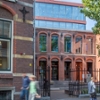 Schouwburgstraat
Schouwburgstraat 2, The Hague
-
About
The Faculty of Governance and Global Affairs is one of a total of seven faculties of Leiden University, located in The Hague.
-
After LUC
Upon receiving their diploma from LUC, our students spread their wings to pursue prestigious master’s degrees, PhD studies or to start their professional careers. Due to the many academic fields that are taught at LUC, the options for their future are vast and diverse. It is unsurprising that LUC’s…
-
Extra challenge
Are you ready to take on an extra challenge during your Leiden Bachelor programme? With options like Honours College, The Humanities Lab and the Academy of Creative and Performing Arts (ACPA) you can add extra depth, intensity and ECTS – even a dual degree – to your study.
-
Lena and Sophie have been selected as Europaeum Fellow: ‘Excited to learn from others’
Four PhD researchers of Leiden University have been selected to participate in the Europaeum Scholars Program 2022-2023. Two of them, Lena Riecke and Sophie Vértiter, are doing their research at ISGA. Time for a introduction.
-
Better screening can help GPs recognise anxiety disorders earlier
Only one in five young people with emotional health problems such as an anxiety disorder receives appropriate professional help. GPs often fail to properly recognise the signals in children and young people, according to psychologist Semiha Aydin. How can we improve this? PhD defence 23 February.
-
Body's own marijuana helps us forget traumatic memories
The endogenous compound anandamide – often referred to as the body’s own marijuana – plays a role in erasing memories of a traumatic event. This was discovered by an international team led by Leiden chemist Mario van der Stelt. The results have been published in Nature Chemical Biology and may provide…
-
‘Sometimes it helps to take some time to think’
He started his career as a part-time PhD candidate and a reading volunteer at his children's school. Now, as a professor, he looks back on forty years of research and education: Peter Klinkhamer of the Institute of Biology Leiden, ecologist in heart and soul.
-
Flooded polder helps fight mosquito-borne diseases
One and a half hectares of polder, a large volume of water, and a group of curious researchers from various universities and scientific backgrounds led by ecologist Maarten Schrama. These are the ingredients needed to answer the question: how do water retention areas affect nature, animals, and our…
-
Virtual children help prevent withdrawal syndrome in real children
When children wean off from heavy medication, they often experience withdrawal symptoms. The severity of these symptoms is often difficult to predict. Pharmacologist Bas Goulooze developed a computer model to determine the best weaning strategy for each child. His research has now been published in…
-
‘Different languages of instruction could help African education move forward’
The high number of students that we are used to in the West would never have been possible if Latin were still the language of instruction in our universities. In his PhD defence on 16 September, Bert van Pinxteren will argue that Africa could gain a lot from a similar language switch in secondary e…
-
Illusions as the key: how spatial technology can help patients
Spatial technology such as virtual reality can help patients who have difficulty with spatial cognition, for instance if they keep on losing their way. In her inaugural lecture, neuropsychologist Ineke van der Ham will talk about the importance of avatars, the patient experience and room for innovat…
-
New toolbox helps scientists measure impact science communication
Scientists regularly appear in the media. They participate in science cafés, write a popular-science book or visit school classes. In that way, they want to convey their knowledge and enthusiasm to society. But do they succeed? To answer that question, a new website is launched, with a toolbox full…
-
From smarter cities to epidemic control: algorithms can help
Where should you plant ten trees so that as many city-dwellers as possible can enjoy them? If a smart algorithm knows how people move through the city and where there are already trees, it can calculate the optimal solution. Data scientist Mitra Baratchi makes this possible. Her students are now using…
-
Electric car batteries can help drive the clean electricity transition
As early as 2030, batteries in electric vehicles could fully meet the need for short-term electricity storage around the world. By connecting them to the power grid they can provide their stored energy, improving energy security and enabling renewable technologies in cleaning the grid.
-
‘Even Ancient and Medieval ideas can help the Modern World’
Ahab Bdaiwi, University Lecturer of Islamic history, religion and philosophy, was received the first Faculty Impact Award. His interest lies in ‘everything that has to do with antiquity’, especially the religious and philosophical ideas that arose at that time. ‘They can move people. And many of those…
-
PhD defense: Op zoek naar onderzoek
On Tuesday 14 February 2017 defended Kees van Gageldonk his doctoral thesis ‘Op zoek naar onderzoek. De totstandkoming van de onderzoekfunctie in het hoger beroepsonderwijs' at the Academy Building of Leiden University. Supervisor of the research is Prof.dr. W. Otterspeer with co-supervisor Dr. P.J.…
-
Hunt for cheap metals that help store sustainable energy
Storing energy is one of the biggest challenges in the energy transition. Hydrogen could be a solution. Chemist Daan den Boer is researching how to make the chemical reaction needed to store energy in hydrogen as cheap and efficient as possible.
-
Ancient Greek decision making with help from the gods
In the world of Ancient Greece the interpretation of supernatural signs was a versatile tool to facilitate decision-making. This is the central hypothesis of the PhD dissertation of historian Kim Beerden. Defence on 14 February.
-
Cartoons help children decide on participation in research
Children are often able to decide for themselves whether they want to take part in medical research. In order to be able to make an informed decision, they need clear information. PhD candidate Ronella Grootens set a good example and created a cartoon story. PhD defence 6 December.
-
Will this discovery help us develop better catalysts?
Where exactly on the surface of a catalyst do the chemical reactions occur? Until now, it has always been a challenge to identify the exact locations of these ‘active sites’. In a new article in Nature, Leiden chemists helped their international colleagues reveal new insights into this issue. Their…
-
Could restricting EU free movement help tackle brain drain?
Eastern and Southern European countries struggle with ‘brain drain’ as skilled workers move to other EU Member States. Could restricting free movement be a legitimate and lawful way to address this trend? Researcher Martijn van den Brink will investigate the issue.
-
Scientists have most impact when they're free to move
An analysis of researchers' global mobility reveals that limiting the circulation of scholars will damage the scientific system.
-
Bureaucracy and fragmented social care system mean people do not receive the help they need
In his PhD research in the field of public administration, Mark Reijnders looked at why people do not receive the help they need. They lose their way in the labyrinthine support system or become bogged down in bureaucracy. In public administration this is known as non-take-up of social care. PhD defence…
-
Roméo Dallaire on “How a better world is possible”: Cooperation between Science and Practice
Leiden University’s Institute for Security and Global Affairs and Dual PhD Centre jointly organize an online lecture on 23 April, 15.00 hrs by Cleveringa Professor General Roméo Dallaire on “How a better world is possible”: Cooperation between Science and Practice.
-
European cooperation on sustainability off to a slow start
Ries Kamphof conducted research into European sustainability policies; his findings are that the European Committee very rarely uses her authority. ‘The member states are very protective when it comes to taking action to protect the climate.’ PhD ceremony on 22 November 2018.